
Self-Guided Classic Old & New Jerusalem
Exploring Jerusalem independently is one of the most rewarding travel experiences in the world, but navigating a city where layers of Crusader, Ottoman, Byzantine, and Roman history collide can easily feel overwhelming. This masterclass itinerary is engineered specifically for the self-reliant traveler.
By following this precise, geographically optimized route, you will seamlessly transition from the ancient stone alleyways of the Old City to the bustling energy of the modern capital. This guide is built to help you outmaneuver the standard tour-bus bottlenecks, bypass aggressive unaccredited street guides, and confidently navigate local transport and cultural expectations entirely on your own.
Before setting out on your journey, your absolute first priority should be safety and situational awareness. For comprehensive, real-time safety protocols, essential emergency contact numbers, and local healthcare navigation, review the Israel Emergency Guide for Tourists. Keep this reference bookmarked on your device so you can explore with complete peace of mind.
What to Pack & How to Dress
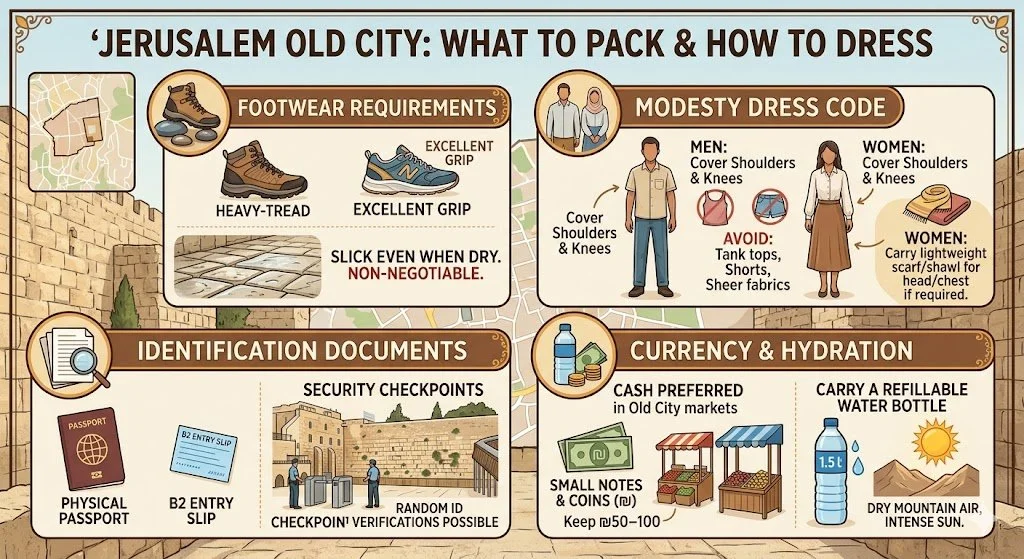
Footwear Requirements: Jerusalem’s Old City alleys are paved with centuries-old limestone that has been polished smooth by millions of feet. It is incredibly slick, even when completely dry. Heavy-tread walking shoes or supportive sneakers with excellent grip are non-negotiable.
Modesty Dress Code: This route traverses highly sensitive religious sites across Jewish, Christian, and Muslim quarters. Both men and women must cover their shoulders and knees. Women should carry a lightweight scarf or shawl in their daypack to cover their chest or head if required at specific entry points. Avoid sheer fabrics, tank tops, and shorts.
Identification Documents: You must carry your physical passport and the small blue entry slip (B2 stay permit) given to you at border control. Security checkpoints around the Western Wall and downtown transit lines can include random ID verifications.
Currency & Hydration: While credit cards are universally accepted in the New City, small market vendors in the Old City strictly prefer cash (Israeli New Shekel - ₪). Keep ₪50–100 in small notes and coins. Jerusalem sits at an elevation of nearly 800 meters; the mountain air is dry and the sun is intense. Carry a refillable 1.5-liter water bottle.
Local Transit & Payment Protocols
Jerusalem’s public transit network is highly modern, efficient, and entirely paperless. The backbone of the city's transit is the Jerusalem Light Rail (Red Line / L1), which perfectly connects the Old City margins to the heart of the New City.
Payment Methods
You cannot purchase paper tickets from drivers. You have three primary validation options:
Contactless Credit Card / Digital Wallet: You can tap your international contactless credit card (Visa/Mastercard), Apple Pay, or Google Wallet directly on the validation terminals inside the boarding platforms.
The Rav-Kav Smartcard: A reloadable transit card that can be purchased and loaded with credit at any Light Rail platform kiosk.
Mobile Transit Apps: Applications like Moovit or Pango allow you to link a credit card, scan a QR code inside the carriage, and digitalize your fare payment automatically.
Validation Rules & Fines
A standard single fare gives you a 90-minute transfer window across the light rail and local buses. You must validate your ride immediately upon boarding or before stepping onto platforms where restricted. Plainclothes fare inspectors board trains constantly; failing to validate properly results in an immediate, non-negotiable ₪180 fine.
For a deep dive into route maps, cross-city bus lines, and regional train schedules, consult the comprehensive Israel Travel Advisor Transportation Guide.
Hourly Breakdown of Stops
08:30 - 09:30 | Zion Gate and the Scars of Modern History
Timing & Duration: 08:30 AM – 09:30 AM | 60 minutes
Navigation Link: Zion Gate
Entry Costs: Free
Physical Accessibility: Moderate slope; cobblestone unevenness under the gate arch.
Dress Code: Standard casual; respect guidelines before entering the nearby Armenian/Jewish quarters.
Geographical Navigation
Begin your tour at the southern rim of the Old City walls. If arriving via taxi or bus, get dropped off at the "Zion Gate" turnaround off Ma'ale Hashalom road. If walking from the Mamilla area, follow the external path south along the base of the western walls, passing Jaffa Gate, until you reach the highly recognizable, stone-carved entrance of Zion Gate (also known locally as Bab an-Nabi Dawud).
Historical Narrative
Zion Gate was constructed in 1540 by the Ottoman Sultan Suleiman the Magnificent. As you approach, the first thing that strikes you is the violent pockmarking covering the limestone facade. These are bullet holes from intense close-quarters combat during the 1948 Arab-Israeli War, when Israeli forces attempted to breach the blockaded Jewish Quarter to relieve its besieged residents. For nineteen years following that conflict, the gate sat on the tense "Green Line" ceasefire border, tightly sealed and backed by concrete bunkers until it was reopened in 1967. The architecture features an intentional L-shaped interior bend—a classic medieval defensive engineering tactic designed to slow down invading cavalry and break the momentum of a battering ram.
On-the-Ground Practical Tip
Before walking through the gate into the city, look up inside the stone archway to view the remnants of a machicolation (a stone overhang or "murder hole") used by Ottoman defenders to pour boiling oil or project munitions down onto attackers. Arriving here exactly at 08:30 AM allows you to photograph the gate completely clear of the heavy tour-group crowds that clog this narrow bottleneck starting at 09:45 AM.
09:45 - 11:00 | The Byzantine Cardo: Walking the Roman Highway
Timing & Duration: 09:45 AM – 11:00 AM | 75 minutes
Navigation Link: HaKardo
Entry Costs: Free (Open-air public sections)
Physical Accessibility: Wheelchair ramps are integrated along the modern walkway, though historical stone paving remains uneven.
Dress Code: Modest attire required; shoulders and knees covered.
Geographical Navigation
From inside Zion Gate, follow the downhill path northward along Chabad Street into the Jewish Quarter. Within 300 meters, look for the signposted stairs and stone arches descending into the exposed, colonnaded canyon of the Cardo Maximus.
Historical Narrative
You are standing on the literal main street of 6th-century Byzantine Jerusalem. Originally commissioned by Roman Emperor Hadrian in 130 CE when he rebuilt the city as Aelia Capitolina, the Cardo was later widened and opulently extended south by Byzantine Emperor Justinian to connect the Church of the Holy Sepulchre to the Nea Church. At over 22 meters wide, this ancient superhighway was lined with covered, shaded porticoes supported by massive limestone pillars to shield shoppers from the Mediterranean sun.As you walk the central pathway, look closely at the deep grooves scored into the bedrock—these are the actual ruts worn down by the iron-rimmed wheels of Roman and Byzantine supply wagons 1,500 years ago.
On-the-Ground Practical Tip
Midway down the exposed Cardo walkway, seek out the large, vibrant mosaic mural reproducing the famous Madaba Map (the oldest surviving cartographic depiction of Jerusalem, originally found in Jordan). It explicitly shows the very pillars you are standing next to. Just past the mural, look for a visual cutout in the floor showing where the massive, thick 8th-century BCE "Broad Wall" constructed by King Hezekiah intersects the Roman design—a masterclass in architectural layering.
11:15 - 12:45 | The Western Wall: Standing Before Antiquity
Timing & Duration: 11:15 AM – 12:45 PM | 90 minutes
Navigation Link: Western Wall
Entry Costs: Free
Physical Accessibility: Fully accessible plaza with ramps; the immediate prayer areas have stone flooring.
Dress Code: Strict religious modesty. Men must wear a headcovering (free cardboard kippahs are provided at the entrance checkpoint). Women must have shoulders and legs covered; pants are acceptable, but long skirts are traditionally preferred.
Geographical Navigation
Exit the northern end of the Cardo, turn right onto Tiferet Yisrael Street, and follow it east toward the broad stone staircases overlooking the Western Wall Plaza. Descend the stairs to reach the security screening checkpoint.
Historical Narrative
The Western Wall (Kotel) is not a wall of the Temple itself, but rather a surviving retaining wall built by King Herod the Great in 19 BCE to support the massive, flattened artificial plateau of the Temple Mount. When Roman legions systematically leveled Jerusalem in 70 CE, this colossal retaining structure survived the destruction due to the sheer size of its masonry.
For centuries, it has stood as the closest accessible point to the Holy of Holies, the spiritual epicenter of the Jewish faith. The lower sections feature monumental Herodian blocks—massive limestone ashlar stones weighing between 2 to 5 tons each, carved with a distinctive, finely drafted border and assembled completely without mortar.
On-the-Ground Practical Tip
The plaza is strictly segregated into male (left) and female (right) prayer sections. Respect the barrier entirely. If you choose to approach the stone to place a written prayer slip in the crevices, remember that it is a strict local cultural taboo to turn your back on the wall when exiting. Step away slowly while facing the stones out of respect.
Crucial Photo Rule: Photography is actively encouraged during weekdays, but if your tour falls on a Saturday (Shabbat) or a major Jewish holiday, cameras, smartphones, and writing instruments are strictly forbidden past the security gates.
13:00 - 14:30 | The Via Dolorosa to the Church of the Holy Sepulchre
Timing & Duration: 01:00 PM – 02:30 PM | 90 minutes
Navigation Link: Church of the Holy Sepulchre
Entry Costs: Free
Physical Accessibility: Low accessibility. Steep, slick stone stairways, dense crowds, and dark, multi-level structural interiors.
Dress Code: Strict Christian modesty. No bare shoulders, no shorts. Men must remove hats/caps before entering the church interior.
Geographical Navigation
Exit the upper Western Wall plaza via the northern exit, passing onto Al-Wad Street in the Muslim Quarter. Turn left and intercept the Via Dolorosa at the 3rd Station of the Cross. Follow the stone markers west up the winding, covered market streets until you emerge into the open courtyard of the Church of the Holy Sepulchre.
Historical Narrative
This route traces the path traditionally walked by Jesus carrying his cross toward Calvary. The route culminates inside the Church of the Holy Sepulchre, a sprawling, architectural puzzle originally constructed by Emperor Constantine's mother, Helena, in 326 CE. The current structure is a fascinating, dizzying blend of Byzantine foundations, Crusader masonry, and localized Ottoman restorations.
It houses the final five Stations of the Cross, covering the site of the crucifixion (Golgotha) and the empty tomb (the Edicule). Because multiple Christian denominations (Greek Orthodox, Roman Catholic, Armenian Apostolic, Coptic, Syrian, and Ethiopian) fiercely share ownership under a strict historical decree known as the Status Quo, not a single stone or item can be altered without absolute consensus.
On-the-Ground Practical Tip
Immediately upon entering the dark church doors, you will see visitors kneeling over a pink limestone slab—the Stone of Anointing. Do not rush past it. Instead, turn immediately right up the steep, narrow stone stairs. This leads you up to the elevated platform of Golgotha. Beneath the main altar, you can reach through a silver disk to touch the actual native bedrock of the hill.
14:45 - 16:30 | The Mahane Yehuda Market: Flavors of the New City
Timing & Duration: 02:45 PM – 04:30 PM | 105 minutes
Navigation Link: The Mahane Yehuda Market
Entry Costs: Free entry; budgeting ₪30–70 for street food sampling.
Physical Accessibility: Flat tarmac and concrete pathways, but extremely dense pedestrian congestion.
Dress Code: Casual, modern street dress.
Geographical Navigation
Exit the Church of the Holy Sepulchre and follow the market alleys westward directly to Jaffa Gate. Step out of the historical walls, cross the plaza, and walk 2 minutes to the Jaffa Gate Light Rail Station. Board the train (Line L1) heading westward towards Mount Herzl. Ride for 4 stops and disembark at the Mahane Yehuda station. The market entrance is directly across Jaffa Street.
Historical Narrative
Established in the late 19th century during the Ottoman era as an unorganized camping ground for Arab peasants selling produce to residents moving outside the Old City walls, "The Shuk" was structurally formalized under the British Mandate with permanent stone avenues.
Today, Mahane Yehuda represents the cultural crucible of modern Jerusalem. It serves as a bustling hyper-sensory grid where traditional Middle Eastern spice traders, old-school fishmongers, secular tech workers, ultra-Orthodox families, and international foodies all collide over piles of fresh produce and artisan goods.
On-the-Ground Practical Tip
This is your designated lunch stop, and you want to completely avoid the sit-down tourist joints lining the outer perimeter. Head straight down the covered central lane (Etz HaChaim Street) and look for small stall vendors serving fresh Sabich (a pita stuffed with fried eggplant, hard-boiled egg, hummus, and amba) or piping hot Knafeh (a Middle Eastern dessert of spun pastry layered with sweet goat cheese and syrup).
Self-Guided Map
Pro Tips for Independent Travelers
Spotting and Avoiding Local Scams
The "Closed Gate" Scam: Near major religious entrances, unaccredited individuals may confidently inform you that a specific gate or church section is closed for a private service, offering to guide you to an "alternative open entrance" for a fee. Ignore them completely and check the gate yourself; doors are almost always open.
Unsolicited Blessings: In the alleys surrounding the Western Wall or Holy Sepulchre, individuals may approach to tie a red string around your wrist or hand you a small religious token as a "gift." Once accepted, they will aggressively demand a hefty cash donation. Politely but firmly say "No, thank you" and keep walking.
Navigating Local Closures (Shabbat and Holidays)
Jerusalem operates on a highly strict religious calendar. From Friday afternoon (around 3:00 PM in winter, 5:00 PM in summer) until Saturday evening after sundown, the Jewish New City completely shuts down for Shabbat (the Sabbath). The Light Rail stops running entirely, stores close, and almost all restaurants lock up. If your day tour happens to fall on a Friday or Saturday, concentrate your time heavily inside the Christian and Muslim Quarters of the Old City, where shops and transit options (like local East Jerusalem buses) remain fully operational.
Deepening Your Historical Knowledge
Understanding the immense historical depth of these paths requires deep context. To trace how the city evolved across the Canaanite, Israelite, Roman, Crusader, and Ottoman periods, review the Israel History Timeline. This framework turns old stone structures into vivid historical narratives.
Managing Your Travel Finances
Jerusalem can present significant budget variations based on where you dine and travel. To plan your day's expenses accurately and prevent unexpected outlays on transport, dining, and entry fees, utilize the Israel Trip Budget Calculator to seamlessly structure your independent travel finances.
Good to Know
We’re here to give you great ideas, but the adventure is yours! The information provided in our day programs is for general guidance only. We hold no official partnerships or responsibility for the independent venues, transport, or operators you choose to visit. Please verify opening hours, local conditions, and booking details independently before you head out.
FAQ
Can you see both the Old City and New Jerusalem in a single day tour? +
What is the strict dress code for visiting religious sites in Jerusalem? +
Which historical sites are included in a classic Jerusalem Old City itinerary? +
What modern landmarks are visited in New Jerusalem day tours? +
Are Jerusalem day tours physically demanding for average travelers? +
Is it safe to take a guided day tour to Jerusalem right now? +
Are entrance fees to Yad Vashem and the Israel Museum covered in tour prices? +
How much time is allocated to lunch during a full-day Jerusalem highlight tour? +
Do Jerusalem day tours operate on Shabbat and religious holidays? +
Where do classic Jerusalem day tours typically pick up and drop off passengers? +
No ads, no commercials, just high-quality content.
If you find our work valuable, we would be grateful for your support. Your contribution helps us continue our mission of providing high-quality content and sharing it with an even wider audience. Support Our Mission
